New clinical approaches in Contemporary Orthodontics
€ Request a quote
€ Request a quote
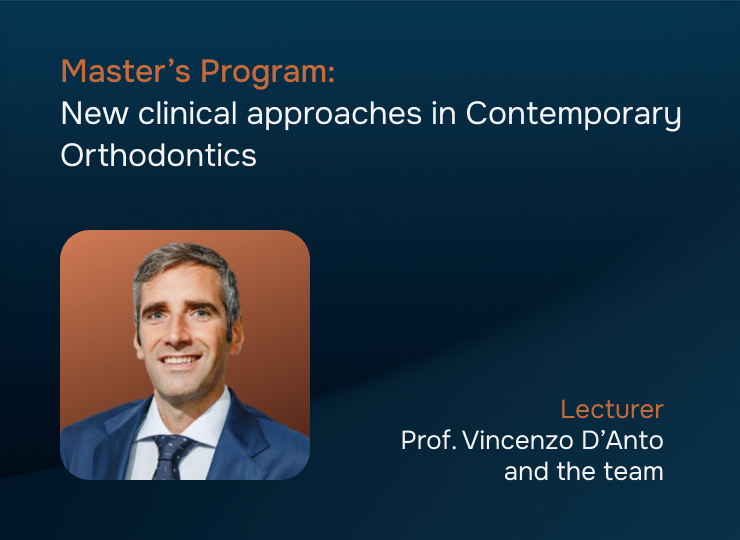
New clinical approaches in Contemporary Orthodontics
Live
09 Nov - 23 Jun, 2027 09:00 - 17:00
CET
University of Naples "Federico II", Naples, Italy
English
Prof. Vincenzo D'Antò
Master’s Program at the University of Naples “Federico II”
The program New clinical approaches in Contemporary Orthodontics covers contemporary orthodontic concepts from diagnosis to finishing, integrating fixed appliance therapy and aligner treatment within evidence-based clinical protocols. Participants will develop practical skills through hands-on training, clinical exercises, and case-based discussions, gaining confidence in managing both routine and complex malocclusions across different age groups.
Main topics include:
- Orthodontic diagnosis, documentation, cephalometry, and visualization of treatment objectives (VTO).
- Fundamentals of fixed appliance therapy, bonding protocols, arch coordination, and biomechanics.
- Clear aligner therapy workflows, biomechanics, auxiliaries, and clinical protocols for common malocclusions.
- Anchorage planning, including skeletal anchorage principles.
- Preventive and interceptive orthodontics and treatment timing in growing patients.
- Treatment strategies for Class I, Class II, and Class III malocclusions with different therapeutic approaches.
- Management of impacted teeth and dental anomalies.
- Finishing protocols, smile aesthetics, retention methods, and long-term stability.
The program is structured to be completed over one academic year. Upon successful completion, participants will be awarded a Master of II Level in Orthodontics Diploma, officially recognizing their advanced training in contemporary clinical approaches.
- Online lectures every second Wednesday from November 9-12, 2026 until June 23, 2027 (except January 6), 9:00 – 11:00 a.m., (CET), 2-hour Live zoom webinars (RECORDINGS WILL BE AVAILABLE).
- 2 weeks on site starting November 9-12 , 2026 & spring 2027.
- Case discussion sessions.
A detailed description of the program is available here.
Registration is available through the Ordoline website or via your local Ordoline representative.
Documents preparation process:
Step 1
Contact an Ordoline representative or write to education@ordoline.com to express your intention to participate in the Master Program.
Step 2 – Deadline: July 1, 2026
Complete the Application Form (the form will be sent to your email after registration and you can fill it online or paper version).
Step 3 – Deadline: July 1, 2026
Schedule an appointment at the Italian Embassy to obtain a Fiscal Code (Codice Fiscale).
Step 4 – Deadline: September 10, 2026
Schedule an appointment at the Italian Embassy to obtain the Dichiarazione di Valore (we recommend if possible, to do it at the same visit as Fiscal Code).
Step 5 – Deadline: September 10, 2026
Submit a Work License (English version or officially translated into Italian).
Step 6 – Deadline: September 30, 2026
Submit the completed University enrollment form and make university payments.