Clear Aligner Treatment from Growing Patients to Adults
€ 449 EUR
€ 449 EUR
Clear Aligner Treatment from Growing Patients to Adults
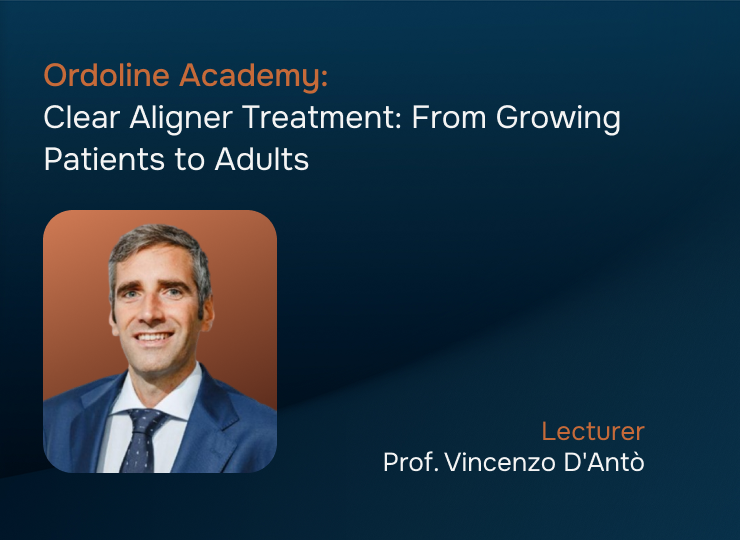
Prof. Vincenzo D'Antò
22 May - 22 May, 2027 09:00 - 17:00
CET
Interleuvenlaan 33, 3001 Leuven, Belgium
English
Course Overview
This course is designed for orthodontists and dentists who wish to deepen their knowledge and clinical skills in clear aligner therapy for growing and adult patients.
The course focuses on diagnosis, treatment planning, biomechanics, clinical protocols, and the management of challenging malocclusions, with particular attention to achieving predictable and clinically efficient results.
Through a combination of evidence-based principles, treatment protocols, and clinical cases, participants will learn to identify the indications, limitations, and appropriate timing of aligner therapy at different stages of growth and development.
The aim is to provide practical strategies that can be immediately incorporated into daily clinical practice, from early treatment in growing patients to comprehensive treatment in adults.
Course Topics
1. Clear Aligners in Growing Patients
- Advantages and limitations of aligner therapy during growth
- Treatment timing and interceptive strategies
- Transition from early treatment to comprehensive treatment
2. Treatment Planning and Digital Workflow
- From diagnosis to digital setup
- Translating the treatment objectives into an aligner prescription
- Staging and sequencing tooth movements
- Overcorrection and working setup: when and how to use them
- Monitoring treatment progress
- Refinements and mid-course corrections
- Improving predictability through digital planning
3. Eruption Guidance and Management of Developing Dentition
- Eruption guidance with clear aligners
- Management of erupting teeth
- Space management during mixed dentition
- Guidance of ectopic eruption
- Management and prevention of impactions
- Clinical protocols for impacted and unerupted teeth
4. Transverse Development
- Diagnosis of transverse discrepancies
- Expansion protocols with clear aligners in growing patients
- Dental versus skeletal expansion
- Predictability and limitations of aligner expansion
- Sequential approaches for transverse correction
- Indications and clinical protocols for MASPE and hybrid expansion approaches
5. Vertical Control: Open Bite and Deep Bite
- Diagnosis and treatment planning of vertical discrepancies
- Open bite treatment with aligners
- Molar intrusion and anterior extrusion: indications and limitations
- Deep bite correction protocols
- Retention and relapse prevention
6. Class II Malocclusion
- Diagnosis and classification of Class II problems
- Growth modification versus dentoalveolar compensation
- Distalization protocols with aligners
- Use of Class II elastics and auxiliaries
- Sequential distalization and anchorage management
- Indications and limitations of aligners in Class II treatment
- Management of Class II in growing versus adult patients
7. Class III Malocclusion
- Early diagnosis and treatment timing
- Dental versus skeletal Class III
- Aligner-based camouflage protocols
- Incisor compensation and transverse considerations
- Use of elastics and skeletal anchorage
- Indications, limitations, and when aligners are not the appropriate treatment option
8. Clinical Case-Based Sessions
The course will conclude with extensive case-based clinical sessions covering:
- Mixed dentition
- Class II malocclusion
- Class III malocclusion
- Open bite
- Deep bite
- Transverse discrepancies
- Eruption problems and impactions
- Complex cases and refinements
Learning Objectives
At the end of the course, participants will be able to:
- Establish appropriate retention and long-term stability protocols.
- Select appropriate patients for clear aligner treatment according to age, growth status, and malocclusion.
- Determine the appropriate timing for early, comprehensive, or one-phase treatment.
- Develop predictable treatment protocols for growing and adult patients.
- Manage transverse, vertical, sagittal, and eruption-related problems with aligners.
- Recognize the clinical limitations of clear aligner therapy and identify when alternative or combined approaches are required.
- Improve digital treatment planning, staging, attachment design, and biomechanics.
- Anticipate common sources of loss of predictability and manage refinements effectively.
This course will be held in English.
Please be informed that the event may be photographed and filmed. By attending, you agree that your image may be used for event publicity purposes.